TOEFL Take an Interview: Urban Futures
In this lesson, you’ll practice four original Question 4 prompts for TOEFL Take an Interview. Question 4 asks you to consider a wider issue or proposed change, make a reasoned judgment or prediction, and explain its effects with the reasons or examples the question requests.
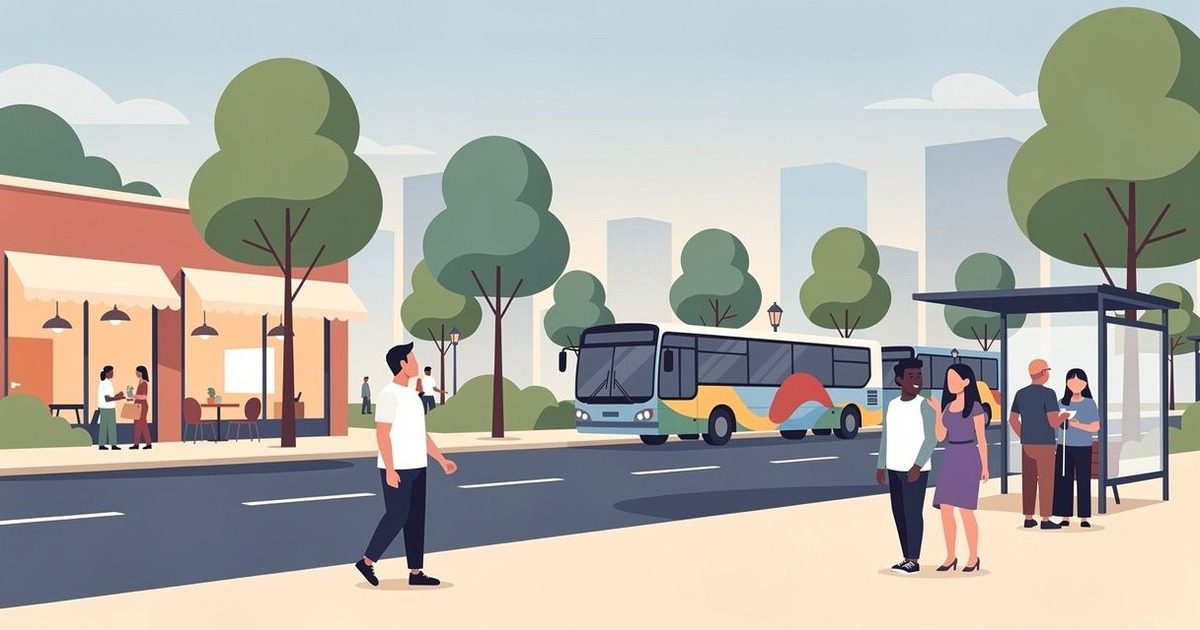
These prompts concern changes in city life. You’ll build urban-life vocabulary, use stand to gain and stand to lose to identify possible effects, and explain what a prediction depends on without presenting it as certain.
VOCABULARY
Urban changes and their effects
These words help describe access, public space, businesses, and the conditions that shape a city’s choices.
route (noun)
A particular path followed by a vehicle or traveler. Synonyms: path, course
The delivery route avoids the steepest hill.
fare (noun)
The price paid for a trip on public transportation. Synonyms: ticket price, travel charge
The train fare increased this spring.
access (noun)
The ability or right to reach or use something. Synonyms: entry, availability
The new ramp improved access to the clinic.
district (noun)
An area of a town or city with a recognizable purpose or identity. Synonyms: area, neighborhood
The arts district has several small theaters.
resident (noun)
A person who lives in a particular place. Synonyms: inhabitant, local person
Each resident received a notice about the water repair.
loading area (noun phrase)
A place where goods can be put into or taken out of a vehicle. Synonyms: delivery bay, loading zone
The shop needs a loading area for early deliveries.
pedestrian (noun)
A person traveling on foot. Synonyms: walker, person on foot
The crossing gives pedestrians more time to reach the other side.
to adapt (verb)
To change in response to new conditions. Synonyms: to adjust, to change
The café adapted its hours when the market opened earlier.
to depend on (phrasal verb)
To be determined or affected by something. Synonyms: to be shaped by, to rely on
The trip’s cost depends on how many people share the car.
trial (noun)
A limited test of a proposed change. Synonyms: test, pilot
The team ran a one-month trial before buying the new software.
GRAMMAR FOCUS
Describe who may benefit or lose
Stand to gain and stand to lose describe a possible benefit or loss if a situation changes. Name the person or group first, then the specific thing they might gain or lose. The construction does not by itself prove that the result will happen.
[Person or group] stands/stand to gain [noun phrase] / stands/stand to lose [noun phrase].
- Name a possible benefit.
Small farms stand to gain new customers if the market opens nearby.
Patients stand to gain faster appointments from the new clinic schedule.
- Name a possible loss.
Late shoppers stand to lose evening access if the store closes earlier.
The team stands to lose experienced staff without a clear training plan.
TEST TIP
State what a prediction depends on
Question 4 is Policy or Prediction. It moves beyond personal preference to a wider change and is judged on a supported judgment, so a plausible effect counts for more than a confident one. A Question 4 prompt may ask what a wider change could do, not what it has already done. Name one plausible effect, explain the connection, and identify a condition that could strengthen or weaken it. A condition keeps your answer precise without making it indecisive.
Illustrative example
A prediction with a visible chain
Proposed change
A town extends its library hours.
Build the prediction step by step
The stronger answer links the change to a particular group, explains the mechanism, and names a condition: longer hours → access after work → possible benefit if staffing supports the schedule. The weaker answer jumps from a proposed change to a universal result that the prompt cannot establish.
TASK PRACTICE
Answer four Question 4 city-change prompts

Imagine that you have volunteered for a research study about how cities may change.
Exam format
On the exam, an AI-generated photorealistic interviewer asks each question on video; this lesson provides the question audio only. You hear each question once, with no preparation time, and you have 45 seconds to respond.
This focused set practices Question 4, Policy or Prediction. The interviewer raises a wider change and asks you to judge its likely effects. A full interview asks four different positions. Record all four answers before opening the model responses.
Review your response
After recording your answer, listen to it with its question in front of you. Check how fully you answered this question and what to improve.
Use your favorite AI chat to analyze your recorded speech by copying the prompt below and submitting it along with your audio recordings.
Copy an AI feedback prompt
Select and copy the text below, then fill in the placeholders in your AI chat. Choose one that accepts audio files.
After your TOEFL urban futures interview practice
In this lesson you answered four Question 4 prompts about proposed city changes, considering wider effects on residents, businesses, and access. Furthermore, you built vocabulary such as route, fare, loading area, and trial for naming concrete conditions.
You learned how to use stand to gain and stand to lose to identify affected groups and possible outcomes. Finally, you practiced linking a prediction to a reason and naming a condition that could change the result.
Next, practice all four question positions in one uninterrupted set in Community Life Full Interview Practice.
See the Take an Interview task guide for the complete format. Browse current lessons on the TOEFL lessons page.
CONTINUE PRACTICING
Explore the slide collections
Turn this lesson into a class-ready sequence with two short vocabulary activities, two Grammar Focus activities, four Question 4 alternatives, audio models, and a worked comparison of bounded and unsupported predictions.