TOEFL Take an Interview: Free Time Questions
This TOEFL Take an Interview free time questions lesson focuses on the Personal Recall opening. You describe a habit, an experience, or something you have observed, then develop your answer with specific details that address every part of the question.
You’ll learn free time vocabulary, complete structures with tend to and have been … for/since, and a strategy for elaborating one central answer before completing four Question 1 prompts with question and model-response audio.

VOCABULARY
Free time vocabulary: Pastimes and downtime
This free time and hobbies vocabulary covers activities, habits, and ways of describing rest that can support factual and personal answers.
pastime (noun)
An activity done regularly for enjoyment. Synonyms: hobby, interest
Photography started as a distraction from work and became a real pastime.
downtime (noun)
Time when you are not working or busy. Synonyms: free time, rest
I protect my downtime on Sundays, because the rest of the week disappears.
to unwind (verb)
To stop feeling tense and begin to relax. Synonyms: relax, wind down
The nurse takes a few slow breaths to unwind after a difficult shift.
to recharge (verb)
To recover your energy after effort. Synonyms: recover, refuel
A quiet lunch break helps me recharge before afternoon meetings.
to socialize (verb)
To spend time with other people for enjoyment. Synonyms: mix, meet up
New employees can socialize with colleagues at the monthly team lunch.
screen time (noun phrase)
Time spent looking at a phone, computer, or television. Synonyms: device time, phone use
The school balances screen time with experiments and classroom discussion.
to get into (phrasal verb)
To become interested in something and start doing it regularly. Synonyms: take up, pick up
I got into climbing two years ago.
to make a point of (phrase)
To do something deliberately and regularly. Synonyms: be sure to, go out of your way to
I make a point of checking the address before sending a package.
on and off (adverbial phrase)
Sometimes, with breaks in between. Synonyms: now and then, intermittently
I have played the guitar on and off since I was about fifteen years old.
to squeeze in (phrasal verb)
To find time for something in a busy schedule. Synonyms: fit in, slot in
She managed to squeeze in a dentist appointment before her afternoon meeting.
GRAMMAR FOCUS
Habits and routines in English
Habits and routines in English can describe what usually happens or how long a repeated activity has continued. Use these two constructions to distinguish a usual tendency from an activity that began in the past and continues now.
Tend to
X tend(s) to [base verb phrase].
Use tend(s) to for something you usually do, even though it does not happen every time. The verb after to stays in its base form.
I tend to check the total before paying a bill.
I tend to ask for written instructions when a procedure is unfamiliar.
She tends to eat her lunch late in the office.
Have been … for/since
X have/has been [verb-ing phrase] for [length of time]. / X have/has been [verb-ing phrase] since [starting point].
Use have/has been plus an -ing form for an activity that started in the past and continues now. It can happen repeatedly; it does not need to be continuous without a break.
- Use for with a duration: Minutes, hours, days, weeks, months, years, or expressions such as a while and a long time.
I have been waiting for twenty minutes.
She has been managing the project for several weeks.
They have been using this system for a while now.
- Use since with a starting point: A clock time, day, date, month, year, or event, such as eight o’clock, Monday, March 12, January, 2020, or I moved here.
We have been waiting since eight o’clock.
I have been training new employees since January.
She has been managing the project since COVID.
TEST TIP
Elaboration
Question 1 is Personal Recall. It asks for a fact, habit, or observation from your own life and is judged on an immediate, clearly developed answer rather than a complicated one, which is why elaboration is the skill it rewards. A Personal Recall answer becomes clearer when a specific detail develops its main fact, habit, or observation. Answer the question directly, then explain a relevant detail instead of moving through unrelated topics.
Useful details include frequency, duration, origin, reason, example, or consequence. Choose the details that help answer the question.
- Frequency—two or three times a week
- Duration—for about a year now
- Origin—since a colleague needed a substitute
- Reason—because my screen time had nearly doubled
- Example—a friend of mine runs in the morning and games at night
- Consequence—it’s the one evening I don’t think about work
Building an answer step by step
Central answer
What is the main fact?
I usually take the bus to work.
Specific detail
What makes that answer more precise?
I catch the 7:20 bus from the stop outside my building.
Connection
Why is that detail useful to the answer?
It gets me there before the morning meeting, even when traffic is heavy.
See the difference
I buy groceries once a week.
I buy groceries on Saturday morning, when the store is quiet.
I buy groceries on Saturday morning, when the store is quiet. I also collect my prescription from the pharmacy next door, so one trip takes care of both errands.
TASK PRACTICE
TOEFL Take an Interview practice for the Personal Recall question
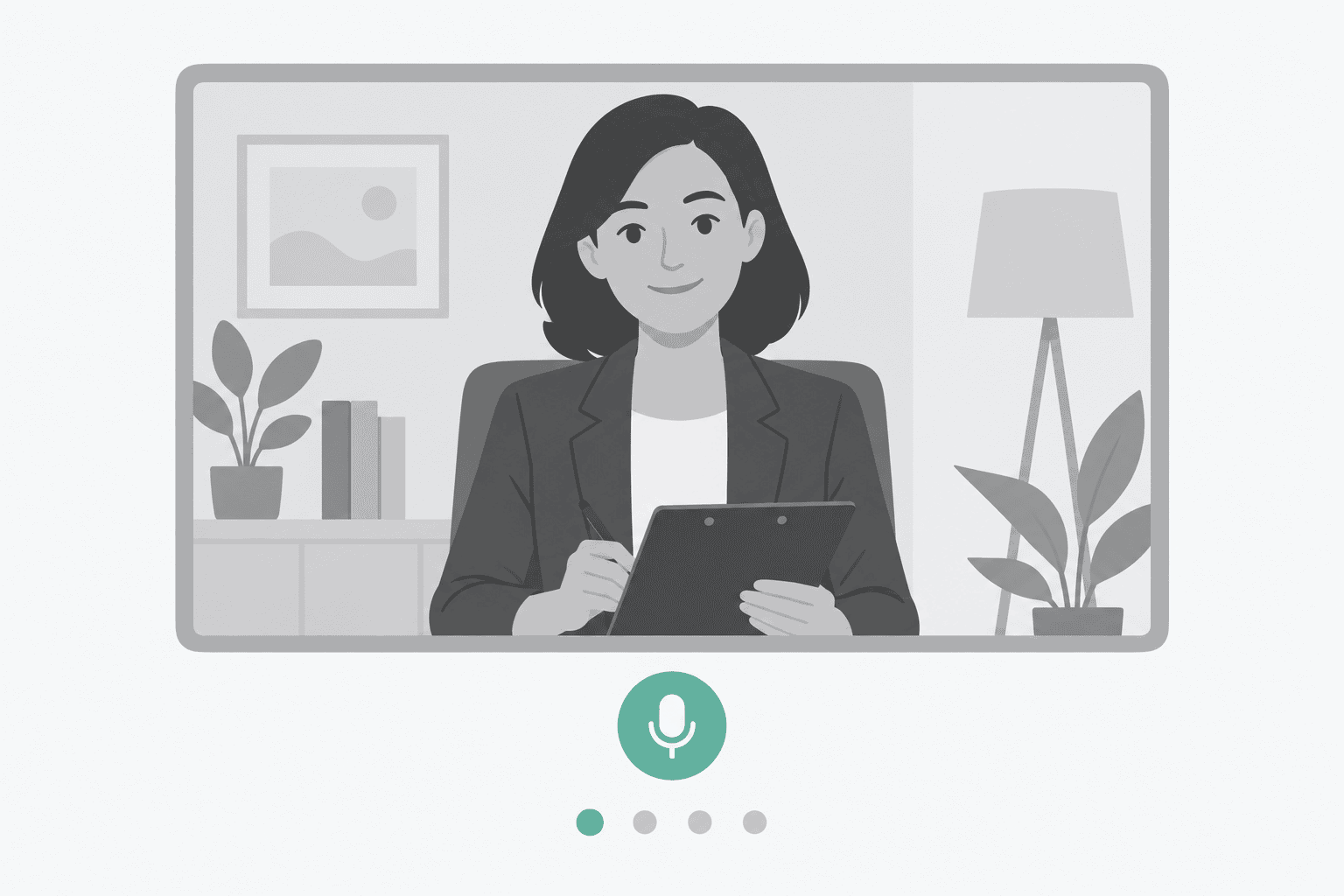
Imagine that you have volunteered for a research study about free time.
Exam format
On the exam, an AI-generated photorealistic interviewer asks each question on video; this lesson provides the question audio only. You hear each question once, with no preparation time, and you have 45 seconds to respond.
This focused set practices Question 1, Personal Recall. The interviewer asks about your own experience, habits, or observations, and you answer from them directly. A full interview asks four different positions. Record all four answers before opening the model responses.
Review your response
After recording your answer, listen to it with its question in front of you. Check how fully you answered this question and what to improve.
Use your favorite AI chat to analyze your recorded speech by copying the prompt below and submitting it along with your audio recordings.
Copy an AI feedback prompt
Select and copy the text below, then fill in the placeholders in your AI chat. Choose one that accepts audio files.
After your TOEFL free time interview practice
In this lesson you answered four Question 1 prompts, developing each central answer with connected details about habits, frequency, origin, reasons, and consequences. Furthermore, you built vocabulary for pastimes and downtime.
You learned how to use tend to for usual behavior and have been … for/since for an ongoing activity. Finally, you practiced making one central Personal Recall answer clearer with specific, connected details.
Next, practice connecting a feature of your choice to a personal consequence in Learning Preferences Take an Interview.
See the Take an Interview task guide for the four-question format and response criteria. Browse current lessons on the TOEFL lessons page.
CONTINUE PRACTICING
Continue with the slide collection
Turn this lesson into a class-ready sequence with a warm-up, guided vocabulary practice, spoken activities using tend to and have been … for/since, an elaboration drill for developing one central answer, and written model responses and comparisons.
Get the Take an Interview collection →