The Air Inside Your Home: B2 English Lesson
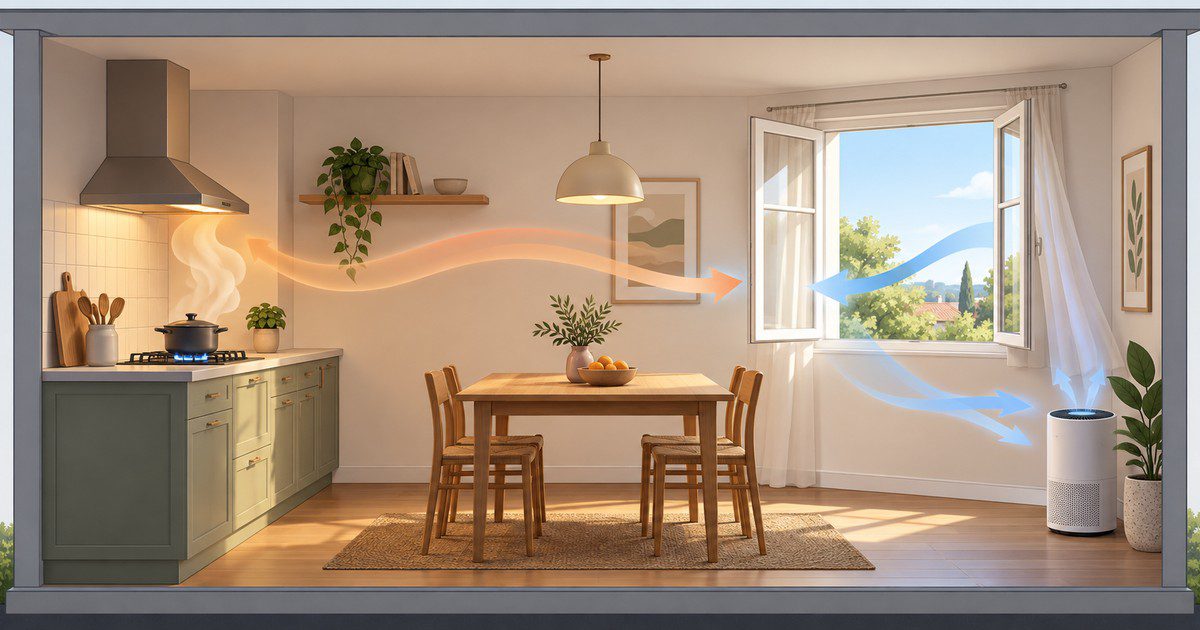
When the air in a room needs improving, where should you start? This B2 English lesson compares removing pollution sources, ventilation, and filtration, then uses have and get something done to describe arranging help with a job.
Vocabulary
KEY WORDS
ventilation (noun)
The movement of fresh air into a building and stale air out of it.
The basement apartment had almost no ventilation, and every smell lingered.
Synonyms: airing, air exchange
pollutant (noun)
A substance that makes air, water or soil harmful or unclean.
The report measured six pollutants at the roadside every hour.
Synonyms: contaminant, impurity
fume (noun)
Strong-smelling gas or smoke, usually harmful to breathe.
We opened every window while the fumes from the varnish cleared.
Synonyms: vapor, exhaust
adequate (adjective)
Enough in quantity or good enough in quality for a purpose.
One small extractor fan is not adequate for a commercial kitchen.
Synonyms: sufficient, satisfactory
to seal (verb)
To close something completely so nothing can pass in or out.
They sealed the gap around the pipe before the cold weather arrived.
Synonyms: to close up, to block
moisture (noun)
Small amounts of water present in the air or in a material.
Moisture behind the tiles had been building up for years.
Synonyms: damp, water content
filter (noun)
A device that removes unwanted material from air or liquid passing through it.
The vacuum works properly again now that the filter has been cleaned.
Synonyms: screen, purifier
IDIOMS
a breath of fresh air (idiom)
Someone or something new and welcome that improves a dull situation.
After three years of the same format, her proposal was a breath of fresh air.
Synonyms: a welcome change, a new lease of life
to clear the air (idiom)
To resolve a disagreement or remove tension by discussing it openly.
A short conversation after the meeting cleared the air completely.
Synonyms: to resolve tension, to talk it out
READ · LISTEN · NOTICE
The Air Inside Your Home
Read at your own pace, or play the audio and follow the passage. Listen again without reading for additional practice.
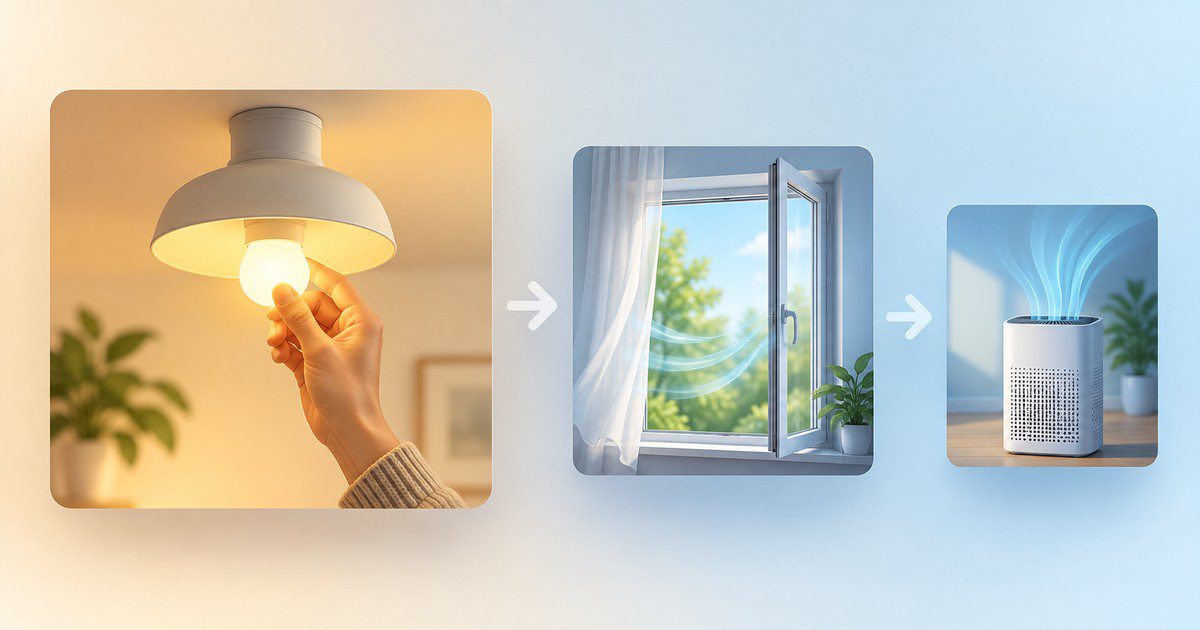
Most people’s instinct about indoor air is to buy something. An air purifier arrives, sits in the corner with a reassuring blue light, and the question feels answered. It is a reasonable instinct and it is the wrong end of the list, because the thing in the corner is the third strategy, not the first.
Start where the pollutant comes from
The most effective approach is source control: removing a source of pollution, or reducing what it gives off. That sounds abstract until you make it domestic. A gas hob can be adjusted so it emits less. A material containing asbestos can be sealed or enclosed rather than disturbed. A hobby that produces fumes can happen in the garage instead of the spare room.
Source control wins on cost as well as effect. Increasing ventilation raises energy bills, because you are heating or cooling air you then push outside. Fixing the source does not. If you only have the attention for one change, this is the one. We had the gas hob serviced last autumn, and that single visit did more than any appliance we could have bought.
Ventilation, and when not to
Second comes moving air. Natural ventilation is unglamorous and mostly free: opening windows and doors, running window or attic fans when the weather allows, opening the vent control on a window air conditioner, and using the extractor fans that already exist above the hob and in the bathroom.
Timing matters more than constancy. The guidance is to maximize ventilation particularly around short bursts of high pollution — painting, stripping paint, cooking, using a kerosene heater, or any maintenance and hobby work that produces fumes. That is a different habit from leaving a window permanently ajar.
There is also a genuine limit, which is easy to forget when ventilation is being recommended. If the air outside is the problem — smoke, a nearby bonfire, refuse — then whether to ventilate has to be judged rather than assumed. You might get an extractor fan fitted above the hob precisely so that you are not depending on the window on days when the outdoor air is poor.
What a filter does and does not do
Air cleaners come last for a reason, and the reason is specific. They are generally not designed to remove gaseous pollutants, which means a device that captures particles well may do nothing at all about the gases that concerned you. The EPA does not recommend using air cleaners to reduce radon or its decay products.
One popular remedy has no support at all. There is currently no evidence that a reasonable number of houseplants removes significant quantities of pollutants from homes and offices. Keep the plants — just not as a ventilation strategy.
Finally, the quiet one: moisture. Keeping humidity below sixty percent, and ideally between thirty and fifty, prevents a whole category of problems that no filter addresses. Getting a damp wall properly investigated is less satisfying than unboxing a purifier, and considerably more useful.
Adapted from US EPA, “Improving Indoor Air Quality”.
GRAMMAR FOCUS
Have / Get Something Done
have / get + object + past participle
Have or get something done puts the focus on what happened to something, rather than on the person who did the work.
- Describe a service someone else performs for you; get is often more informal
“We had the heating system serviced before the cold weather.”
“I need to get my eyes tested before the prescription expires.”
- Describe a completed arrangement without naming the worker
“She has had the kitchen repainted since you last visited.”
“They got the contract reviewed by a lawyer first.”
- Use have for an unwanted event you did not arrange
“He had his bike stolen outside the station.”
“We had our flight canceled twice in one week.”
Discuss the ideas
Work through the discussion questions on your own, or with a teacher or partner.
- What could a building manager reasonably do to improve shared indoor spaces, and in what order?
- Describe something in your home you have had repaired or replaced. Was it worth what it cost?
- This lesson puts buying a device last. Where else do people reach for a purchase before a cheaper fix?
- Opening a window is not always the right answer. How should someone decide on a day when the outdoor air is poor?
- Houseplants turn out not to clean the air meaningfully. How do ideas like that keep circulating, and does it matter?
What this indoor air quality English lesson developed
In this B2 English lesson on indoor air quality, you worked through source control, ventilation, and filtration in order of effectiveness, learned what an air cleaner does not do, built vocabulary for pollutants, fumes, and moisture, and practiced have and get something done for arranged services.
CONTINUE PRACTICING
Continue with the slide collection
Turn this lesson into a class-ready sequence with a warm-up, guided vocabulary practice, dedicated activities for the causative and TOEFL Take an Interview speaking, reading and listening practice, and brief teacher notes with suggested timing and learning objectives.
Explore the lesson deck →