The Fundamental Attribution Error: C1 English Lesson
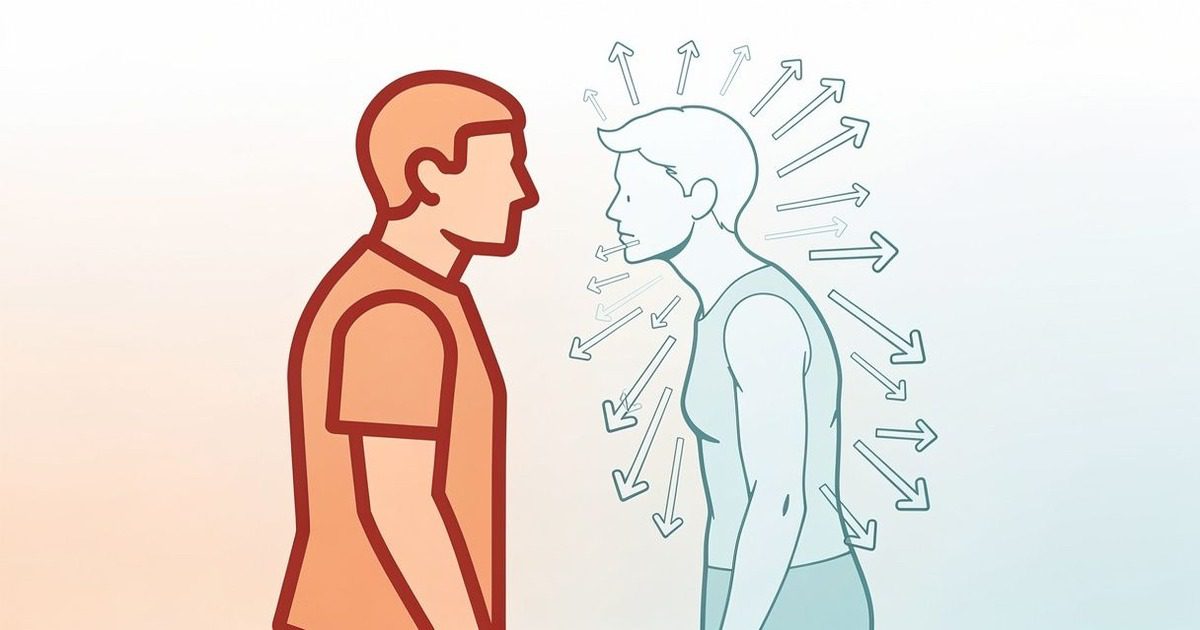
This C1 English lesson on the fundamental attribution error explains why observers read settled character into behavior that circumstances largely dictated, and what the original experiment actually showed. It builds vocabulary for attribution, disposition, and circumstance, and practices contrastive parallelism with whereas and while to set two balanced claims against each other.
Vocabulary
KEY WORDS
to attribute (verb)
To state that something was caused by a particular person, quality or factor.
Reviewers attributed the delay to poor planning rather than bad weather.
Synonyms: to credit, to ascribe
disposition (noun)
A person’s settled tendency to behave in a certain way.
A cheerful disposition is not the same as a good mood.
Synonyms: temperament, nature
circumstance (noun)
A condition or fact surrounding an event that affects it.
Because the road was closed, the driver arrived late; that circumstance mattered more than his usual punctuality.
Synonyms: condition, situation
temperament (noun)
The general character and emotional style a person shows.
Her temperament suits negotiation better than confrontation.
Synonyms: nature, disposition
to misjudge (verb)
To form a wrong opinion about someone or something.
He misjudged the distance and arrived late.
Synonyms: to miscalculate, to misread
charitable (adjective)
Generous in the way it interprets someone’s behavior.
A more charitable reading of her silence is that she had not seen the message.
Synonyms: generous, forgiving
to blame (verb)
To hold someone responsible for something bad.
The report blames the schedule, not the crew.
Synonyms: to fault, to hold responsible
IDIOMS
to walk a mile in someone’s shoes (idiom)
To imagine another person’s situation before judging them.
Before criticizing the night staff, walk a mile in their shoes.
Synonyms: to see their side, to put yourself in their place
to give someone the benefit of the doubt (idiom)
To choose the more favorable explanation when the evidence is unclear.
She gave the new supplier the benefit of the doubt after one late delivery.
Synonyms: to assume good faith, to judge favorably
READ · LISTEN · NOTICE
The Fundamental Attribution Error: C1 English Lesson
Read at your own pace, or play the audio and follow the passage. Listen again without reading for additional practice.
In 1967, Edward Jones and Victor Harris provided students with essays on Fidel Castro. Some defended him, and others opposed him. The students then tried to work out what each writer really believed.
The condition that should have settled it
The experiment focused on a single variable. Half the readers were told the writer had chosen which side to argue. The other half were told the position had been assigned by the experimenters. In the assigned condition, the essay should not have revealed the writer’s views. An essay that has been assigned shows what the writer was instructed to produce, not what the writer personally thinks.
That expectation was wrong. Readers who knew the position had been assigned still judged pro-Castro writers as more favorable toward Castro than anti-Castro writers. The restriction had been clearly stated, was understood, and was nevertheless mostly ignored.

What the pattern is, and what it is not
This tendency was given the name the fundamental attribution error. A situation may explain a behavior at least as well as disposition. Yet observers attribute the behavior to disposition, whereas the assigned position is treated as background.
The experiment shows how clear behavior can outweigh a less visible constraint. Readers knew about the assignment but still misjudged the writer. The essay made temperament seem vivid, while the assigned position remained an abstract fact.
The pattern does not mean observers are stupid. Reading character from behavior is fast and can sometimes be reasonable. The error occurs when an observer still blames disposition after a strong circumstance is known.
The hidden consequences
The consequences matter most when the situational constraint is significant but hidden. For example, a colleague who misses deadlines may seem unreliable. If that colleague is caring for a sick parent, the same behavior has another possible explanation. A more charitable interpretation requires information that is often unavailable.
The same error applies on a larger scale. Applied to an individual, it can produce an unfair judgment that a single conversation might correct. Applied to a group whose circumstances are consistently overlooked, it can become a settled belief about what those people are like.
A harsh judgment may reflect missing information rather than a person’s character. A more generous interpretation still demands evidence; it does not assume that temperament never matters.
GRAMMAR FOCUS
Contrastive parallelism with whereas and while
[clause A] , whereas / while [clause B] — with the two clauses built to the same shape
Whereas and while set two complete claims directly against each other. The contrast reads most clearly when the clauses are parallel: the same word order, the same tense, and the same kind of subject on both sides. Whereas is the more formal of the two and marks contrast only. While can also mean at the same time, so it needs a context where contrast is unmistakable.
- Parallel subjects: the same structure on both sides
“The observer explains the person, whereas the actor explains the pressure.”
“Sales rose in the north, whereas they fell steadily in the south.”
- Fronted contrast: the clause comes first for emphasis
“Whereas the first trial measured recall, the second measured recognition.”
“While the older system logged every request, the new one records only failures.”
- While for a contrast that is not a time relation
“The method is cheap, while the equipment it needs is not.”
“The proposal is popular internally, while clients remain unconvinced.”
Discuss the ideas
Work through the discussion questions on your own, or with a teacher or partner.
- Which recent judgment of another person would change if the circumstances behind it were known?
- Why did the assigned-essay condition fail to remove the inference?
- Where does an organization systematically reward explanations based on character rather than conditions?
- What information would a manager need before treating repeated lateness as a disposition?
- When is it reasonable to conclude that behavior really does reveal character?
What this social judgment English lesson developed
This C1 English lesson used the 1967 Castro essay experiment to show why an observer reads disposition into behavior that circumstances largely produced, and why the tendency persists even when the constraint is stated. It built vocabulary for attribution, disposition, circumstance, and blame, and practiced contrastive parallelism with whereas and while to hold two balanced claims against each other.
Next lesson: Reading the Weather Inside
CONTINUE PRACTICING
Continue with the slide collection
Turn this lesson into a class-ready sequence with a warm-up, two vocabulary activities, a five-question reading check, original listening practice, controlled and spoken practice of whereas and while, and an IELTS Part 3 discussion with model answers.
Explore the lesson deck → →