TOEFL Academic Reading Practice: Water Clocks
Practice Read an Academic Passage with this TOEFL academic reading lesson on water clocks. One original passage and five questions explore how a device turns a physical change into a reading.
Learn vocabulary for measurement and design, use by + -ing to explain a method, and learn to answer rhetorical-purpose questions.
Measurement and design
These ten words describe containers, controlled processes, and the readings they produce.
KEY WORDS
interval (noun)
A period of time between two events or points. Synonyms: period, time span
The medicine must be taken at regular intervals.
vessel (noun)
A container used to hold a liquid. Synonyms: container, receptacle
The cook poured the sauce into a clean vessel.
to regulate (verb)
To control a process so that it operates within chosen limits. Synonyms: to control, to adjust
A thermostat helps regulate the room temperature.
steady (adjective)
Continuing at a rate or level that changes little. Synonyms: consistent, even
She maintained a steady pace along the path.
mechanism (noun)
A set of connected parts that makes a device work. Synonyms: working parts, system
The repairer examined the door’s locking mechanism.
scale (noun)
A set of marks used to read a measurement. Synonyms: graduations, measurement marks
The thermometer’s scale was difficult to read.
to calibrate (verb)
To check and adjust a measuring device against a known standard. Synonyms: to standardize, to adjust
The laboratory must calibrate the balance before use.
fluctuation (noun)
A change up or down in a rate, level, or amount. Synonyms: variation, change
A sudden fluctuation in demand affected the shop’s orders.
outlet (noun)
An opening through which a substance can leave. Synonyms: exit, opening
A leaf had blocked the pipe’s outlet.
precision (noun)
The quality of being exact and carefully controlled. Synonyms: exactness, accuracy
The jeweler cut the small pieces with precision.
GRAMMAR FOCUS
By + -ing for method
A method explains how an action is carried out. A purpose explains what the person hopes to achieve. In an academic explanation, separating these relationships helps keep a procedure distinct from the reason for using it.
[subject] + [verb phrase] + by + [verb]-ing + [complement]
Use by + -ing to name the means of achieving the action in the main clause. The same participant normally performs both actions. For comparison, to + base verb can name a purpose. In Mina saved space by folding the chairs, folding is the method. In Mina folded the chairs to clear the room, clearing the room is the purpose. The method phrase can also come first, provided its understood subject remains clear.
Lina reduced travel costs by sharing a car with a colleague.
The musician improved her timing by recording each rehearsal.
The team protected the files by making a second copy.
By asking for two references, the buyer checked the seller’s reliability.
The volunteers reached more residents by translating the notice.
The technician located the fault by testing each connection separately.
TEST TIP
Rhetorical purpose: explain why the author includes it
Recognize the question. A stem such as “Why does the author mention …?” signals a rhetorical-purpose question. It asks why the author includes a detail, example, or comparison.
Answer it. Read the example and the sentences around it. Ask what the example helps the author explain. Choose the answer that states that role.
Example question
Museums sometimes display tools whose wooden parts have decayed, leaving only metal pieces. A small bronze implement in one collection survives without its handle. Its working end has a narrow opening and a slightly curved point. The label lists the object’s date and metal composition, but those facts alone do little to show how it was handled. The curator therefore compares the surviving end with a modern needle and describes the motion of drawing fiber through dense material. A drawing beside the label shows where a handle may once have fitted.
Why does the author mention the curator’s comparison with a modern needle?
Why the other choices fail
A — Why it does not answer the question. The label gives the date and material, but the passage says those facts do little to explain how the tool was handled.
B — Why it does not answer the question. The comparison helps explain a possible use; the passage gives no evidence about which tool works better.
D — Why it does not answer the question. The drawing suggests where a handle may have fitted; the needle comparison does not prove its shape.
TASK PRACTICE
Read an academic passage about water clocks
Read the passage and choose one answer for each question. Keep the passage available as you work. You may move between questions and change your choices before revealing the key.
One academic passage of about 200 words and five questions. On the test the passage stays on screen while one question appears at a time, with four written choices each. Choose one answer for every question and move forward within the time given for the module.
Turning Water Movement Into Time
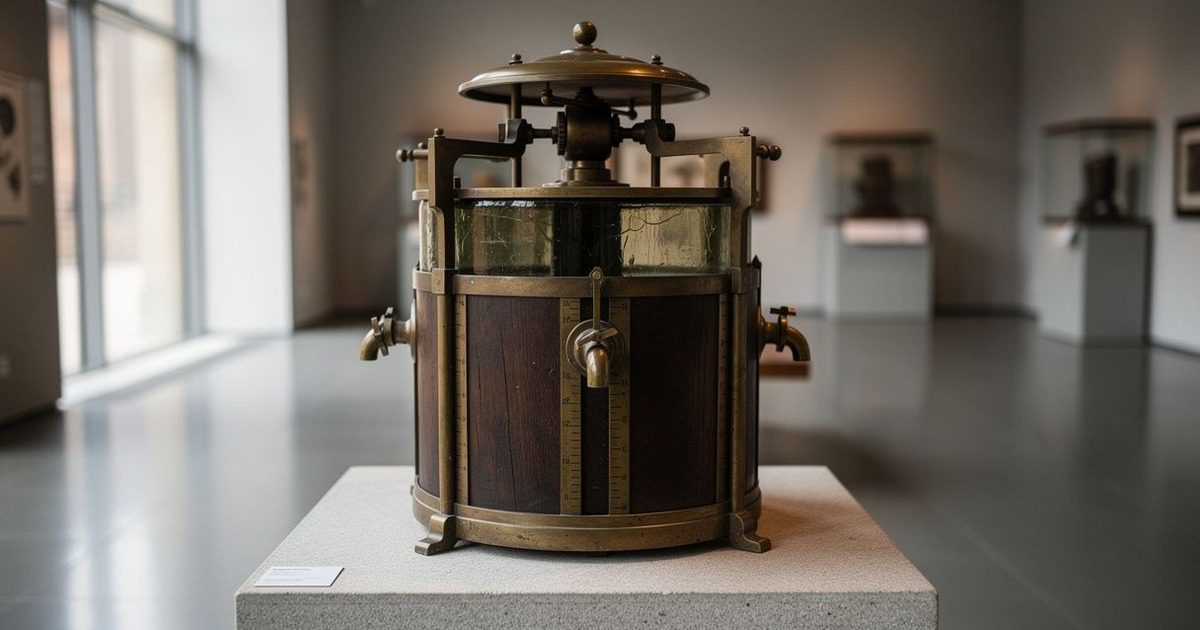
Water clocks measured time through the movement of water rather than the position of a shadow. They could therefore be used when sunlight was unavailable. In one design, water escaped through a small opening near the bottom of a vessel. Marks inside the container related its falling water level to the passage of time.
The relationship between level and time required care because equal drops in a simple, straight-sided vessel could represent unequal intervals. As the vessel emptied, less water pressed down above the opening, reducing the pressure that drove the flow. Water could consequently leave more slowly near the bottom of the scale than near the top. The same distance between two marks would then take longer to pass at the lower level.
Designers worked on this problem by regulating pressure to make the flow more constant. More elaborate clocks also contained mechanisms that moved pointers or rang bells. These features communicated the reading, while pressure regulation addressed the process used to produce it. A useful clock needed both a sufficiently regular process, which remained difficult to control, and a way to display its progress.
How did the design described in paragraph 1 indicate the passage of time?
The word “elaborate” in paragraph 3 is closest in meaning to
Why does the author discuss equal drops in water level in paragraph 2?
According to paragraph 3, what was the direct purpose of regulating pressure?
Suppose a maker adds a bell to a water clock but leaves its water-flow system unchanged. What does the passage suggest?
Reveal the answer key
1. A · 2. B · 3. D · 4. C · 5. B
Review your reading
After completing all the questions, use the passage and answer key to review your choices. Apply these checks to correct answers as well as mistakes: a correct guess still needs an explanation. Use what you find to choose one skill to practice next.
What this TOEFL academic reading practice developed
This water clocks reading practice examined the relationship between a process and its measurement. The five questions asked for precise details, contextual meaning, an example’s purpose, and a supported inference.
You learned how by + -ing explains how an action is carried out. The Test Tip introduces rhetorical-purpose questions and shows how to identify what an example contributes to the surrounding explanation.
CONTINUE PRACTICING
Access the complete lesson deck
Turn this lesson into a class-ready sequence with two vocabulary activities, controlled and spoken practice of by + -ing for method, and worked explanations for all five questions. The deck also includes a warm-up, speaking practice, and brief teacher notes with suggested timing and objectives.
Browse slide decks on Gumroad →