What Is in Your Takeaway Cup? B2 English Lesson
What can a hot takeaway cup tell us about tiny plastic particles, and what can it not tell us about health? This B2 English lesson follows the lab evidence and uses reporting verbs with that-clauses to keep the findings and their uncertainties clear.

Vocabulary
KEY WORDS
particle (noun)
An extremely small piece of a substance.
A single particle of dust on the lens was enough to spoil the photograph.
Synonyms: fragment, speck
to release (verb)
To let something escape or be given off into the surroundings.
Warm soil releases moisture into the air on a spring morning.
Synonyms: to give off, to emit
to detect (verb)
To discover or notice something that is difficult to see or measure.
The alarm can detect smoke long before anyone in the building smells it.
Synonyms: to identify, to sense
concentration (noun)
The amount of a substance contained in a particular volume or area.
The concentration of salt in the soup was higher than the recipe intended.
Synonyms: density, strength
microscopic (adjective)
So small that it can only be seen using a microscope.
A drop of pond water holds microscopic life that the eye cannot resolve.
Synonyms: minute, tiny
conclusion (noun)
A judgment reached after considering the available evidence.
The committee delayed its conclusion until the final survey results arrived.
Synonyms: finding, verdict
trace (noun)
A very small quantity of something, often barely measurable.
Inspectors found only a trace of the chemical in the water supply.
Synonyms: hint, small amount
IDIOMS
to take something with a grain of salt (idiom)
To accept a claim while keeping some doubt about it.
He says the job takes ten minutes, but I’d take that with a grain of salt.
Synonyms: to treat with caution, to doubt slightly
the jury is still out (idiom)
A decision has not yet been reached because the evidence is incomplete.
New batteries may last twice as long, but the jury is still out on their safety.
Synonyms: it remains undecided, no verdict yet
READ · LISTEN · NOTICE
What Is in Your Takeaway Cup? B2 English Lesson
Read at your own pace, or play the audio and follow the passage. Listen again without reading for additional practice.
You lift the lid off a hot coffee and steam rises into the cold air. Nothing about the cup looks remarkable. Yet inside it, a thin plastic layer is sitting against water near boiling point — and researchers have been asking a simple question about that moment. What, if anything, comes off?
Measuring what you cannot see
Scientists at the United States National Institute of Standards and Technology set out to count it. They lined up ordinary single-use hot drink cups, whose inner surface is coated with low-density polyethylene, filled them with water at one hundred degrees Celsius, and left them for twenty minutes. Then they measured what the water carried.
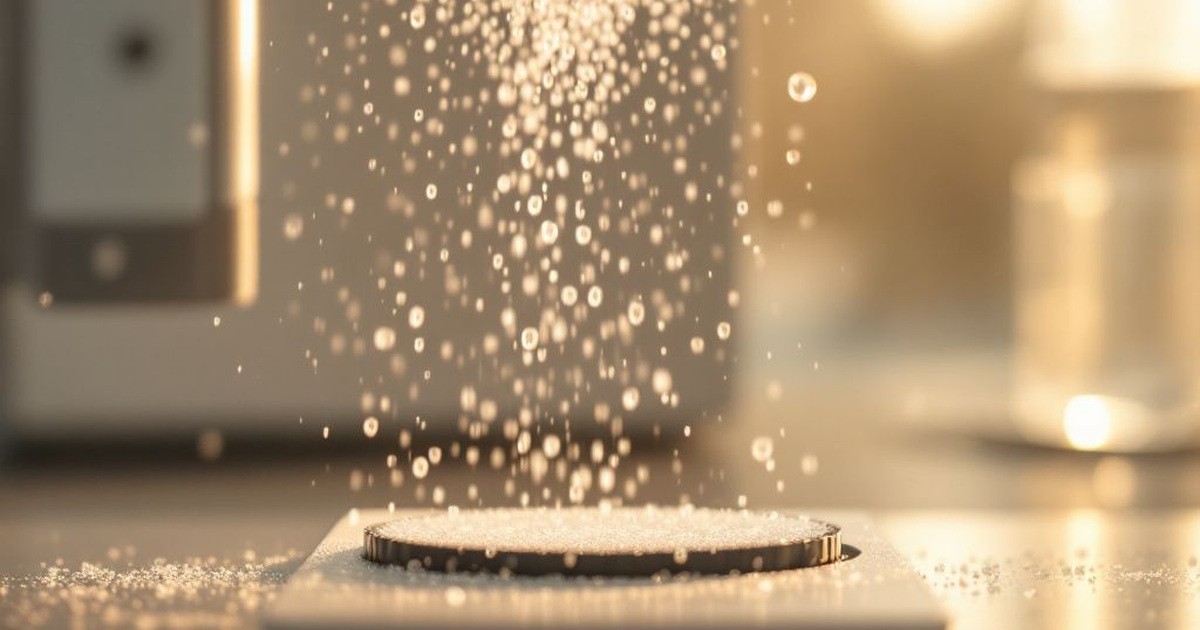
Counting something that small is the hard part. The team sprayed the water into a fine mist, dried it, sorted the remaining particles by size and by electrical charge, and grew them in butanol vapor until a machine could see them well enough to count. Their measurements showed that a single liter held particles numbering in the trillions, most of them between thirty and eighty nanometers across — far below the one-micrometer line that separates a nanoplastic from the larger fragments people usually picture.
The gap between a number and a risk
Here is where careful language matters. A very large number invites a very large conclusion, and the researchers declined to draw one. They said that they did not know whether the particles have bad health effects on people or animals. No one, they added, has established that nanoparticles of this kind disrupt human cells.
That is not a dodge. Detecting a substance and demonstrating harm are separate scientific tasks, and only the first has been done here. A trace can be real, measurable, and repeatable while its consequences remain genuinely open. The study was also not limited to cups: food-grade nylon baking bags released particles at roughly seven times the concentration, which tells you the finding is about heated plastic in general rather than coffee in particular.
Reading the next headline
When this research reaches the news, the hedge is usually the first thing to disappear. A report may suggest that a household object releases trillions of particles, and the sentence is true — but a reader who stops there has quietly replaced a measurement with a warning.
The practical response is neither alarm nor dismissal. You can reasonably decide to pour a hot drink into your own cup, while recognizing that you are acting on an open question rather than a settled one. Knowing which of those two you are looking at is the skill worth carrying out of this lesson.
Adapted from NIST (2022), “NIST study shows everyday plastic products release trillions of microscopic particles into water”.
GRAMMAR FOCUS
Reporting Findings with That-Clauses
reporting verb + (that) + subject + verb
A that-clause helps you report a finding while keeping its original level of certainty.
- Use show or confirm for a finding the source presents as definite
“The survey showed that most residents walked to work at least twice a week.”
“Our records confirm that the order was delivered on the fourteenth.”
- Use suggest or indicate when the source is more cautious
“The report suggests that shorter meetings improve concentration.”
“Early sales figures indicate that the new opening hours are working.”
- Keep may, might, or could inside the clause when the source remains uncertain
“The authors wrote that the effect might disappear in larger groups.”
“My doctor explained that the symptoms may have a simple cause.”
Certainty scale: show that → found that → suggest that → may suggest that (most certain to least certain)
Discuss the ideas
Work through the discussion questions on your own, or with a teacher or partner.
- A news headline states that a common household item is dangerous. What would you want to know about the original study before you accepted the headline?
- Think of something you changed in your daily life because of health information. Looking back, how strong was the evidence you were acting on?
- Scientists in this lesson refused to say whether the particles are harmful. Is that refusal reassuring or frustrating to you, and why?
- A friend tells you to stop using takeaway cups immediately. What would you say to them, and what would you avoid claiming?
- When a question stays open for years, how should a person decide what to do in the meantime?
What this plastic particles English lesson developed
In this B2 English lesson on plastic particles in hot drinks, you followed a measurement from a laboratory bench to a newspaper headline, built vocabulary for traces, concentrations, and conclusions, and practiced reporting findings with that-clauses while keeping the uncertainty that the researchers themselves preserved.
Next lesson: Continue with The Air Inside Your Home to investigate another everyday exposure that is easy to overlook.
CONTINUE PRACTICING
Continue with the slide collection
Turn this lesson into a class-ready sequence with a warm-up, guided vocabulary practice, dedicated activities for reporting verbs and IELTS Part 3 discussion, reading and listening practice, and brief teacher notes with suggested timing and learning objectives.
Explore the lesson deck →