Fermented Food, Live Cultures, and the Label: B2 English Lesson
A fermented food, a product with live cultures, and a product claiming a probiotic benefit are different things. In this B2 English lesson, learn to separate those claims on a label and use both … and and neither … nor to make precise comparisons.
Vocabulary
KEY WORDS
microbe (noun)
A living thing too small to see, such as a bacterium.
Most microbes in soil are harmless and many are useful to plants.
Synonyms: microorganism, germ
to preserve (verb)
To treat something so that it keeps for longer without spoiling.
Her grandmother preserved half the summer crop in jars each August.
Synonyms: to conserve, to keep
regulation (noun)
An official rule controlling how something may be made or sold.
New regulations required every supplier to record the origin of the meat.
Synonyms: rule, control
supplement (noun)
A product taken in addition to your normal diet.
He takes a vitamin D supplement through the winter months.
Synonyms: additive, extra
beneficial (adjective)
Having a helpful or favorable effect.
Ten minutes of daylight in the morning is beneficial for most people.
Synonyms: helpful, advantageous
claim (noun)
A statement that something is true, made without full proof.
The advertisement’s central claim was never supported by any trial.
Synonyms: assertion, statement
variety (noun)
A particular type of something within a larger group.
This variety of apple keeps its texture much better when cooked.
Synonyms: type, kind
IDIOMS
the proof is in the pudding (idiom)
The real value of something is shown only by testing it in practice.
The design looks impressive, but the proof is in the pudding once the users arrive.
Synonyms: results speak for themselves, the test is in the trying
a gut feeling (idiom)
A strong instinct about something that you cannot explain with reasons.
I had a gut feeling about the apartment before I had seen the kitchen.
Synonyms: an instinct, a hunch
READ · LISTEN · NOTICE
Fermented Food, Live Cultures, and the Label
Read at your own pace, or play the audio and follow the passage. Listen again without reading for additional practice.
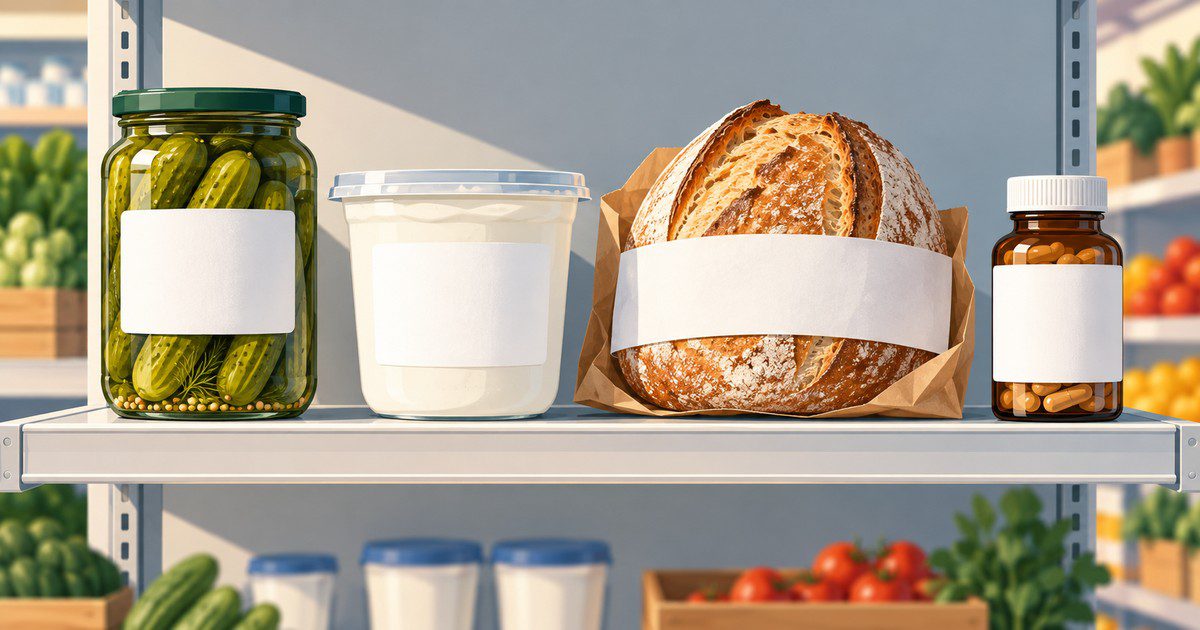
There is a jar of pickles in your fridge, a pot of yogurt beside it, and possibly a bottle of capsules in the cupboard promising to support your gut. All three are commonly filed under the same vague heading. They are not the same thing, and the difference is written on the label if you know what to look for.
Three different things
Fermentation is a preserving method. People have used microbes to transform food for thousands of years — bread, cheese, pickles, sourdough, soy sauce — and the point was to keep food edible and to change its flavor. That is a process, not a health category.
Live cultures are a separate question. Some fermented foods still contain living microbes when you eat them; others do not. Both sourdough bread and many jarred pickles undergo fermentation, yet neither the baked loaf nor the pasteurized jar reliably delivers live organisms to you, because heat is part of how they were made or kept.
Probiotics are narrower still. The working definition is live microorganisms intended to have health benefits when consumed or applied to the body. That phrase carries a burden of proof, and it is the point where the shelf and the science part company.

Why the strain is the whole question
Here is the detail that most packaging omits. Different types of probiotic may have different effects, and the effects do not transfer between them. If a specific kind of Lactobacillus helps prevent a particular illness, that tells you nothing about another kind of Lactobacillus, and less still about any Bifidobacterium. Strain, dose, and the population studied all change the answer.
This is why the evidence reads as it does. There is moderate support for use in antibiotic-associated diarrhea in children and non-elderly adults, and promising but uncertain results for irritable bowel symptoms. Beyond that the honest summary is that it is still not known which probiotics are helpful and which are not — conclusions are repeatedly described as tentative, of moderate quality, or inconclusive, precisely because studies used different strains at different doses in different people.
What a label can and cannot tell you
Regulation follows that uncertainty, and it is not one rule but two. A product sold as a dietary supplement does not need approval before going on sale, and it may not claim to prevent disease. A product sold as a drug has to bring clinical trial evidence and win approval first. Those are two completely different standards behind two products that can look almost identical on a shelf.
Safety deserves the same care. For most healthy adults these foods are unremarkable, but severe and sometimes fatal infections have been reported in premature infants given probiotics, and regulators issued a warning to providers about exactly this. Anyone seriously ill or immunocompromised is in a different risk category from a well adult eating yogurt.
None of this is an argument against fermented food, which is worth eating for flavor, variety, and the ordinary pleasure of it. It is an argument for reading one specific line on the packaging: both the strain and the amount, not the word on the front.
Adapted from NCCIH, “Probiotics: Usefulness and Safety”.
GRAMMAR FOCUS
Both … And / Neither … Nor
both + phrase + and + phrase; neither + phrase + nor + phrase
Use both … and to join two true statements and neither … nor to reject two possibilities. Keep the phrases on each side parallel.
- Joining two nouns or noun phrases: place the two items in matching positions.
“Both the morning and the evening sessions were fully booked.”
“Neither the receipt nor the packaging had a batch number on it.”
- Joining two adjectives: describe one subject with two parallel qualities.
“The room was both cheaper and quieter than the one we saw first.”
“The route is neither direct nor especially scenic.”
- Joining two verb phrases: keep the actions parallel as well.
“She both wrote the proposal and presented it to the board.”
“He neither called ahead nor left a message.”
Discuss the ideas
Work through the discussion questions on your own, or with a teacher or partner.
- What should a food label explain before a shopper can reasonably judge a health claim?
- Think of a product you bought because of something written on the front of the package. What did the back of the package actually say?
- Supplements and medicines can face very different approval standards. Is that reasonable, and where would you draw the line?
- Which fermented foods are part of the cooking you grew up with, and what were they for?
- A friend says a particular probiotic worked for them, so it will work for you. Based on this lesson, how would you respond?
What this fermented food English lesson developed
In this B2 English lesson on fermented food and probiotics, you separated fermentation, live cultures, and probiotic claims, learned why strain and dose decide the answer, built vocabulary for labels, claims, and supplements, and practiced both … and and neither … nor with parallel phrases.
Related lesson: Continue with What Is in Your Takeaway Cup? to practice distinguishing a measured finding from a broader health claim.
CONTINUE PRACTICING
Continue with the slide collection
Turn this lesson into a class-ready sequence with a warm-up, guided vocabulary practice, dedicated activities for correlative conjunctions and IELTS Part 3 discussion, reading and listening practice, and brief teacher notes with suggested timing and learning objectives.
Explore the lesson deck →