Yoga Beyond Being Flexible: B2 English Lesson
Yoga involves more than reaching a difficult pose, but what has research actually measured? This B2 English lesson looks at balance, strength, and adaptable practice while using could and was able to to distinguish general past ability from one particular achievement.
Vocabulary
KEY WORDS
posture (noun)
A particular position of the body, held deliberately.
The physical therapist corrected his posture before he lifted anything heavy.
Synonyms: position, pose
flexibility (noun)
The ability to bend or be bent easily without damage.
Years at a desk had cost him the flexibility he once took for granted.
Synonyms: suppleness, give
balance (noun)
A steady position in which weight is evenly distributed.
Carrying two full bags, she lost her balance on the icy step.
Synonyms: stability, steadiness
to adapt (verb)
To change something so it suits a different situation or person.
Good teachers adapt the same material for very different classes.
Synonyms: to adjust, to modify
injury (noun)
Physical harm or damage to the body.
A knee injury kept him out of the team for the rest of the season.
Synonyms: harm, damage
preliminary (adjective)
Early and not yet final; coming before fuller work.
These are preliminary results, and the full report follows in March.
Synonyms: initial, provisional
modification (noun)
A small change made to something to make it more suitable.
One simple modification to the chair made the whole workspace usable.
Synonyms: adjustment, alteration
IDIOMS
to bend over backwards (idiom)
To make an unusually large effort to help or accommodate someone.
The hotel bent over backwards to find us a room after the delay.
Synonyms: to go out of one’s way, to make every effort
to find your feet (idiom)
To become confident and capable in a new situation.
It took her a term to find her feet, and after that she was fine.
Synonyms: to settle in, to gain confidence
READ · LISTEN · NOTICE
Yoga Beyond Being Flexible
Read at your own pace, or play the audio and follow the passage. Listen again without reading for additional practice.
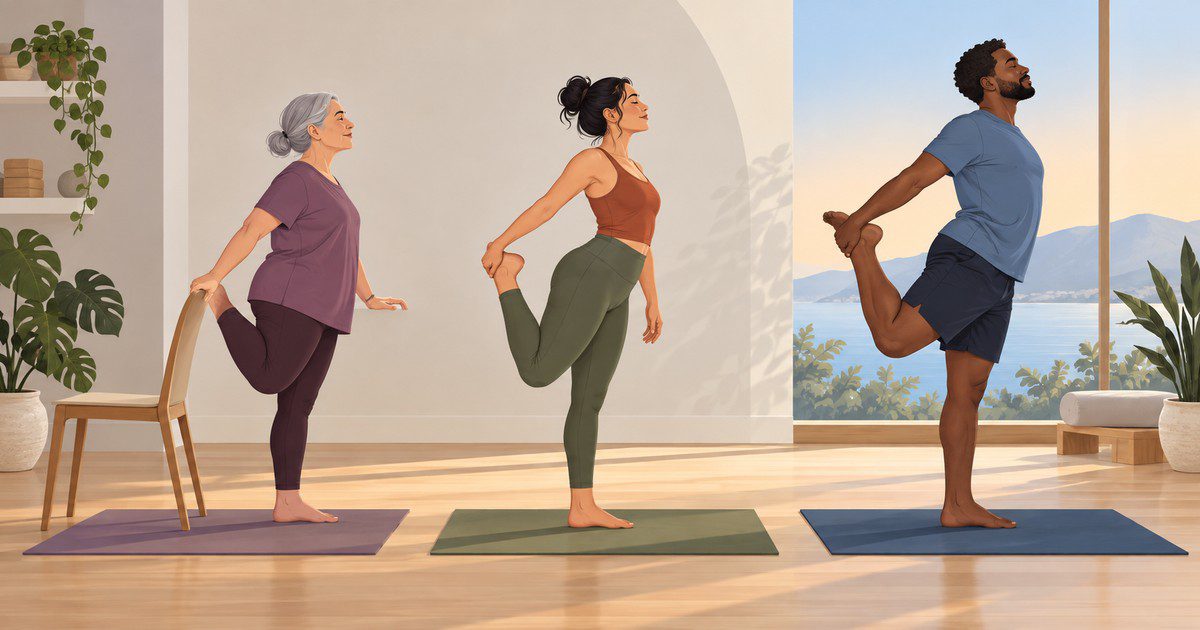
Ask someone to picture yoga and you will usually get a photograph: a young, very flexible person holding a shape most people cannot reach. It is a strange image to have inherited, because flexibility is neither the point of the practice nor the thing researchers have spent most of their time measuring.
What the practice actually contains
Yoga is an old and complex tradition rooted in Indian philosophy, and what reaches a modern class is only part of it. A typical session emphasizes three things together: physical postures, breathing techniques, and meditation. The postures are the visible element, which is why they dominate the photographs, but a class that drops the other two has kept the least distinctive third.
That combination matters for reading the research. When a study reports an effect, it is reporting on a whole program, often over several weeks, and not on any single shape. Before she started, she could hardly stand on one leg for ten seconds; what changed over the following weeks was the accumulated practice, not one posture mastered.
What has actually been measured
The honest summary is that the evidence is uneven, and worth reading carefully rather than in a headline.
For balance, a review of fifteen studies covering 688 participants found improvements in eleven of them — though only five of those fifteen were randomized trials, and all of them looked at people who were already healthy. For perceived stress, a review of twelve studies with 672 participants found beneficial effects in all twelve. For back pain, a 2022 review found yoga slightly better than no exercise at all — but noted the difference may not be important to patients, and a separate report put its effects at roughly the level of other exercise. For anxiety, one review of 38 studies found a substantial benefit, while a later review looking specifically at diagnosed anxiety disorders could not reach a conclusion, because there were not enough rigorous studies to support one.
Read together, that is a practice with reasonable support for balance and stress, a modest and contested effect on back pain, and an open question for clinical anxiety. It is also research done on a narrow group: participants have been predominantly female, white, well educated and comparatively well off, and people from minority and lower-income groups are underrepresented. A finding drawn from that sample is a preliminary answer about that sample.
Adaptation is the actual skill
Yoga is generally considered safe when it is done properly under a qualified instructor, and serious injuries are rare. The exceptions are specific rather than general: adults over sixty-five turn up in emergency departments at higher rates, and anyone pregnant, older, or managing a health condition has a real reason to speak to a clinician first.
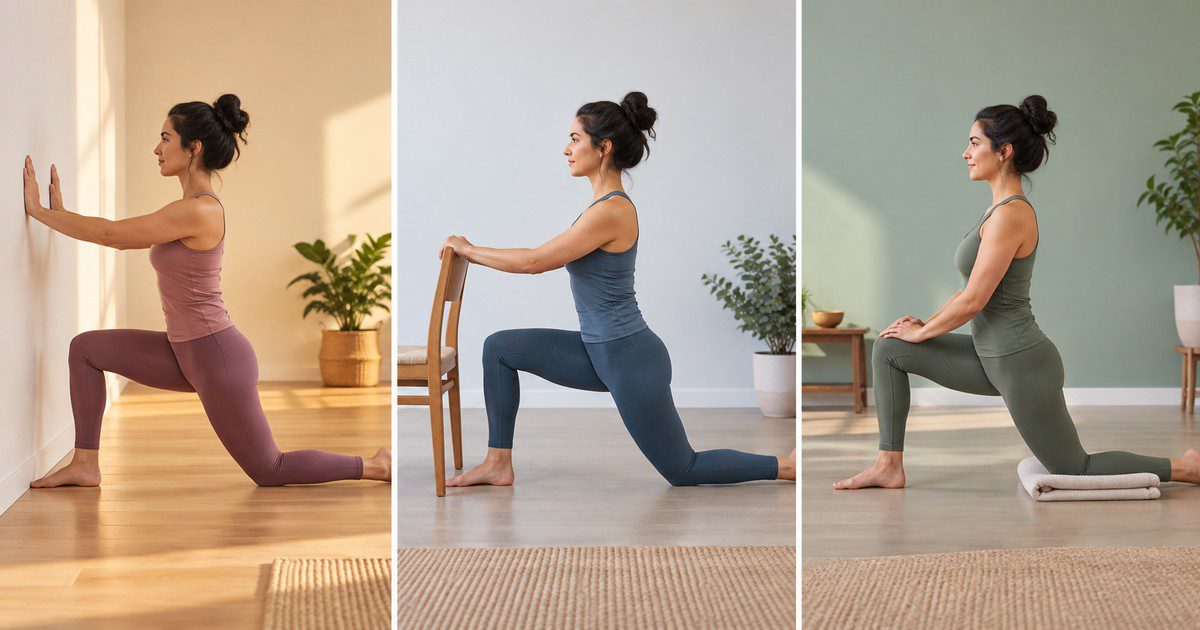
What follows from all this is not caution for its own sake. It is that the useful skill in a class is modification — a chair, a wall, a folded blanket, a shorter hold. Last week he was able to do the whole sequence for the first time, because the version he was doing had been adapted to the body he actually has.
Adapted from NCCIH, “Yoga: Effectiveness and Safety”.
GRAMMAR FOCUS
Could and Was / Were Able To
could + base verb; was / were able to + base verb
Use these forms to describe what someone was capable of doing in the past. The form you choose depends on whether you mean a general ability or one particular result.
- General ability over a period: use could for something you were capable of doing regularly.
“She could read music before she started school.”
“At twenty he could run a marathon without much training.”
- One particular achievement: use was/were able to when someone succeeded on one occasion.
“After three attempts we were able to open the window.”
“Despite the strike, I was able to reach the airport on time.”
- Negative ability: couldn’t and wasn’t/weren’t able to can both describe something someone could not do.
“I couldn’t hear the announcement over the noise.”
“We weren’t able to find a table anywhere in the old town.”
Discuss the ideas
Work through the discussion questions on your own, or with a teacher or partner.
- Describe a physical activity you learned, including one adjustment that made it possible for you to take part.
- Think of something you could do easily a few years ago. What has changed, and does it matter to you?
- The research in this lesson mostly studied one narrow group of people. What difference might that make to someone outside that group?
- A friend says yoga cured their back pain. Based on this lesson, what would you accept and what would you question?
- Describe a class, course, or club where you had to find your feet. What helped you most in the first few weeks?
What this yoga English lesson developed
In this B2 English lesson on yoga and the research behind it, you separated a popular image from the evidence, read what reviews have actually found about balance, stress, back pain, and anxiety, built vocabulary for adaptation and injury, and practiced could and was able to for past ability.
Next lesson: Continue with Fermented Food, Live Cultures, and the Label to examine another familiar health claim through measured evidence.
CONTINUE PRACTICING
Continue with the slide collection
Turn this lesson into a class-ready sequence with a warm-up, guided vocabulary practice, dedicated activities for past ability and IELTS Part 2 long-turn speaking, reading and listening practice, and brief teacher notes with suggested timing and learning objectives.
Explore the lesson deck →